Showing posts with label consecration. Show all posts

SRI SRI RADHA KRISHNA TEMPLE OF DEVOTION AND UNDERSTANDING OPENS IN SEBERANG JAYA, MALAYSIA


Sri Sri Radha Krishna temple, the First Vedic Temple of Devotion and Understanding (TODU) had performed consecration on the August 29th, 2015 between 10am – 1pm. It was done in conjunction with Sri Bala Purnima & Holy Appearance Day of Lord Balarama. The temple was built and designed according to the principles of ancient vedic geomancy a.k.a. “Vaasthu Shastra”.

Image above: Bird's eye-view of the octagonal Sri Sri Radha Krishna temple at Seberang Jaya, Penang, Malaysia.
 
It is the largest Radha Krishna temple in South East Asia which is now open to the public. The octagonal shaped 3 storey temple worth RM10 million with 16 ornate dome-shaped pavilions (chatris) is located in Seberang Jaya, Penang, Malaysia. The 30.5m tall building includes 12 lion figurines sitting on top of 3 Shikara domes rising up to 26m. These ornamental works was done by 14 artisans that were brought from India. The octagonal & pyramidal shape is designed for natural light penetration & ventilation.

The temple established by the International Society for Krishna Consciousness (ISKCON) provides free food during lunch time every Fridays also proposes to instruct devotees on Yoga, chanting, spirituality, run an educational center which also includes a Srila Prabhupada Gallery. Simheswara, the building committee chairman explained that “the locations of the 16 chatris on the octagon were aligned with the celestial rulers of the 8 directions. Each direction, North, South, East, West, Northeast, Northwest, Southeast and Southwest represents the various incarnations or avatars of Lord Krishna.”

ISKCON National General Secretary Simheswara Dasa explained that the temple was modeled after India’s 2 famous temples which are Jagannath in Puri & Krishna Balaram in Vrindavan. This temple was envisioned by the society’s founder, CC Bhaktivedanta Swami Prabhupada when he made a visit to Malaysia in 1971. He had then left a rough sketch of the temple with instructions for the devotees here to follow. It has come to reality now after 44 years. Swami Prabhupada passed on to the other side in 1977 but his legacy continues for decades even after he has left.

The building has an elevator which was built with the elderly in mind and a few of the rooms will be used to store Lord Krishna’s attire and flowers. The mezzanine floor was dedicated to the founder as the Srila Prabhupada Gallery in conjunction with the 50th anniversary of ISKCON. Lord Krishna and Radha will be placed in the main temple hall on the first floor while the 10 statues of the incarnations of Lord Krishna will also be placed within the temple.

Adjacent to the building is a 4 storey multipurpose hall which has an open dining hall to provide free vegetarian food, 10 guest rooms & a viewing gallery. Meanwhile, the cultural centre at the hall will house a restaurant, a gift and Vedic books shop, an education centre plus meeting rooms.

Here are some snapshots that I captured during the consecration ceremony for the benefit of those who missed this auspicious ceremony:


Photo above: Street was filled with shops with vendors selling refreshments and other HK centres selling books.
Photo above: Banner at Front right of entrance welcomes the devotees in various languages.

Photo above: View from the front entrance of the new building
Photo above: Side view of the temple

Photo above:  Devotees singing and dancing in ecstasy inside the main hall before the consecration ceremony
Photo above: A unique view at the octagonal ceiling of the main hall at 1st floor


Photo above:  A drone can be seen from the air capturing the footage of the consecration ceremony 

 Photo above: Crane carrying HH Jayapataka Swami Maharaj for the consecration ceremony past noon.

 Photo above: HK volunteers pouring holy consecrated water on the devotees
 Photo above: Devotees swarming at HH Jayapataka Swami Maharaj as soon as he reaches ground after the consecration ceremony

Food was served concurrently while the ceremony was going on and Balarama Purnima Festival was observed on the same day from 6pm until 9pm. Mandala Abishegam Ubhayam will follow for the next 48 days beginning August 30th until October 16th.  

CONTRIBUTION:
Picture credit: The first photo of the bird’s eye-view of building courtesy of Malaysian Insider

The Miracle of Lanciano


 Image: The relic at display


Image: Relic close-up


 Image 2: Relic close up


The flesh and blood of Christ is still being preserved in the church of San Francesco in Piazza Plebiscito at Lanciano, Italy. It all started in 750 AD, when a Basilian monk while celebrating the holy mass at St. Legontian Church at Lanciano. The monk started to have doubts on the real presence of Jesus Christ in the consecrated holy species. As soon as he pronounced the words of “consecration” (this is my body, this is my blood), the monk witnessed the host changed into a living piece of flesh and the wine turn into real blood.

Image: Church of San Francesco in Piazza Plebiscito


Analysis of the specimen – by Dr. Edoardo Linoli
A brief biography of Dr. Edoardo Linoli


Dr. Edoardo Linoli is a professor of anatomy and pathological histology, chemical & clinical microscopy, and former head of the Laboratory of Pathological Anatomy at the Hospital of Arezzo. He was the only doctor who analyzed the relics from the miracle of Lanciano.

Authorization from church officials to have the relics examined scientifically
In November 1970, the archbishop of Pacifico Perantoni of Lanciano, the provincial minister of the Franciscan Conventuals of Abruzzo with the authorization of Rome mooted an initiative to have the relics examined scientifically.

Linoli and his assistant analyzed and concluded their findings.
Linoli was assisted by Dr. Rugerro Bertelli, also a retired professor of human anatomy at the University of Sienna. The analysis work covered on the relic, the miraculous flesh and blood were extracted with great care by Linoli and made the analysis. He presented his findings on March 4, 1971.

The following are his findings:
The flesh is real flesh, the blood is real blood. The flesh consists of the muscular tissue of the heart (myocardium). The flesh belongs to the human species. The flesh and blood have the same blood type which is AB. In the blood, there were traces of proteins in the same normal proportions as found in the sero-proteic make up of flesh and normal blood. There were also traces of minerals found in this blood such as Chlorides, Phosphorus, Magnesium, Potassium, Sodium and Calcium.

The relic sample matches with the man from the Holy Shroud of Turin
In the interview with Zenit, Linoli further explained,”as regards to the flesh, I had in my hand the endocardium. Therefore, there is no doubt at all that it is cardiac tissue.” In regards to the blood, “the blood group is the same as that of the man of the Holy Shroud of Turin, and it is particular because it has the characteristics of a man who was born and lived in the Middle East regions. The AB blood group of the inhabitants of the area in fact has a percentage that extends from 0.5-1.0% while in Palestine and the region of the Middle East; it is 14-15%”

He says, “Though it is alien to my task, strictly speaking, I feel that I should insert the following reflection into the study just completed: the classification which comes through in these studies, of the nature of flesh gives little support to the hypothesis of a “fraud” perpetrated centuries ago. As a matter of fact, supposing that heart may have been taken from a cadaver, I maintain that only a hand experienced in anatomic dissection would have been able to obtain from a hollow internal organ such a uniform cut as can still be glimpsed in the flesh.

Another characteristic property of the blood sample was that when liquefied, it has retained the chemical properties of freshly shed blood. Usually, when we cut ourselves and stain our clothes with blood, the chemical properties of our blood is gone within 20 to 30 minutes. If blood is not refrigerated within an hour, the composition will rapidly break down. If blood was taken from a dead body, it will lose its qualities quickly through decay. The blood sample analyzed by Dr. Linoli is believed to be over 12 000 yrs old. It still contains all its properties, chemicals and proteins of freshly shed blood. It was further testified that were no preservatives found in the blood.

World Health Organisation appoints commission to verify Linoli’s claims
In 1971, his report was published in "Quaderni Sclavo di Diagnostica Clinica e di Laboratori". Following this, in 1973, World Health Organisation appointed a scientific commission to verify Linoli’s report. The task consisted of 500 types of examination which took 1 year 3 months to complete. The conclusion of these tests does not vary with Linoli’s findings. As a result, in 1976, the extract of scientific research of WHO’s medical commission was published in New York and Geneva that confirmed that science was unable to explain this phenomenon.

CONTRIBUTION:
Zenit.org

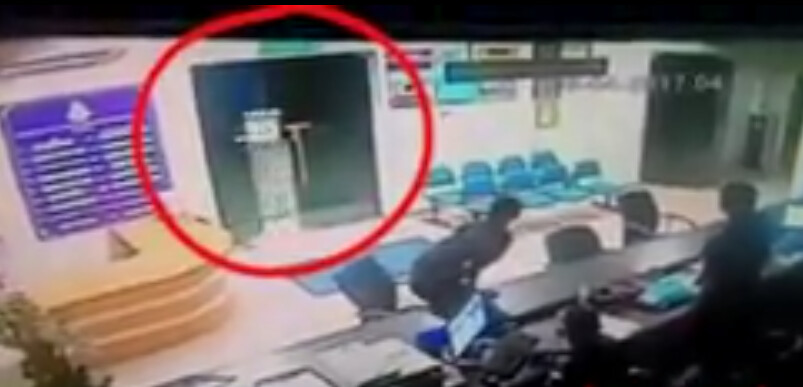
A GRAVE VISIT DURING GRAVEYARD SHIFT AT THE POLICE STATION

Cops on graveyard shift duty at Bandar Hilir police station experienced an incident that sent a chilling shock straight to their spines....